
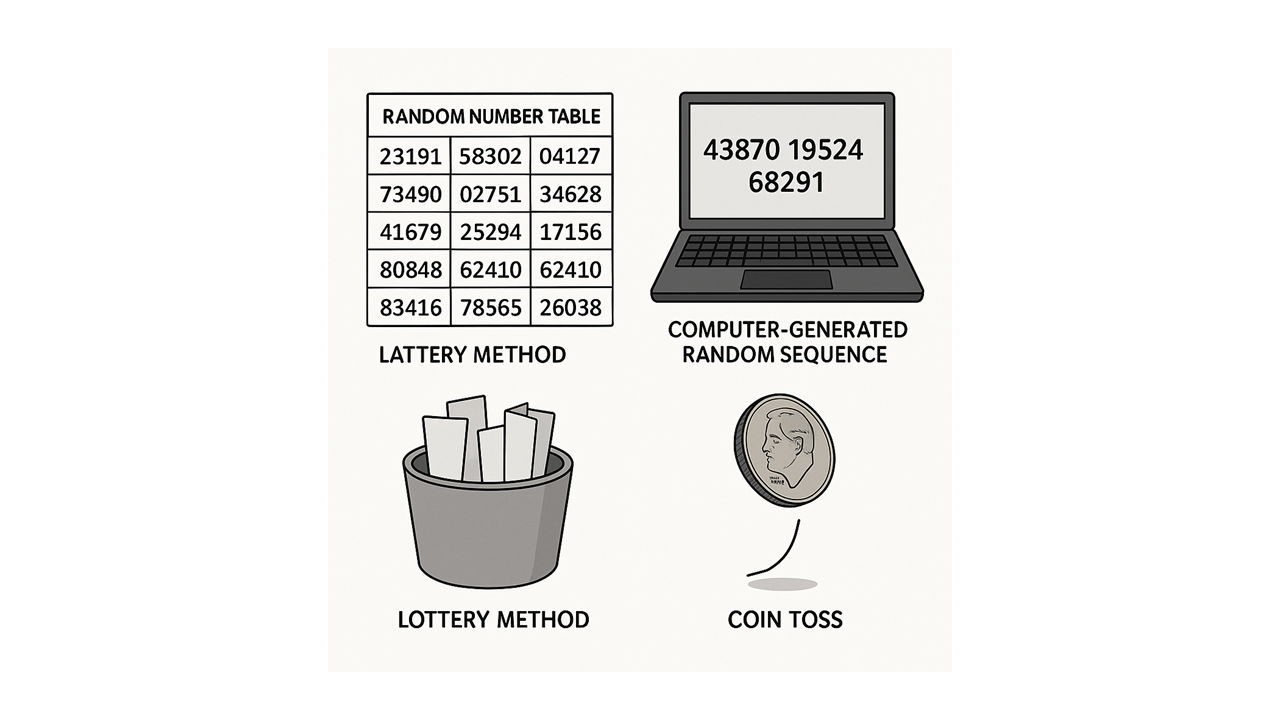
🎲 **Four Common Randomization Methods Used in Clinical Research**
Randomization is an essential component of randomized controlled trials (RCTs). It involves assigning participants to different study groups using a chance-based process, helping to minimize selection bias and improve comparability between groups.
🔹 **1. Random Number Table**
A random number table contains a sequence of randomly generated numbers that can be used to allocate participants to different study groups.
✅ **Example:** Participants are assigned unique identification numbers. Numbers selected according to a predefined rule determine allocation to Group A or Group B.
📌 **Best used for:** Research studies where randomization is performed manually without computer software.
🔹 **2. Computer-Generated Random Sequence**
A computer program generates a random allocation sequence using statistical software such as SPSS, R or other randomization tools.
✅ **Example:** A computer-generated sequence assigns 100 participants randomly to Group A (intervention) or Group B (control).
📌 **Best used for:** RCTs requiring reproducible, well-documented and potentially more complex randomization procedures.
🔹 **3. Lottery Method (Drawing Lots)**
Participants are assigned to study groups by drawing identical folded slips or lots from a container.
✅ **Example:** Identical slips labelled A and B are placed in an opaque container, mixed thoroughly and drawn to determine group allocation.
📌 **Best used for:** Small-scale studies where randomization needs to be conducted manually.
🔹 **4. Coin Toss Method**
A fair coin is tossed to determine the allocation of participants to one of two groups.
✅ **Example:**
Heads → Group A (Intervention)
Tails → Group B (Control)
📌 **Best used for:** Small studies involving two groups, where simple random allocation is appropriate.
🎯 **Important Considerations for Thesis and Dissertation Writing**
✔ Generate the random allocation sequence before assigning participants, where applicable.
✔ Maintain allocation concealment to prevent investigators from predicting upcoming assignments.
✔ Distinguish randomization from random sampling. Random sampling selects participants from a population, whereas randomization assigns enrolled participants to study groups.