
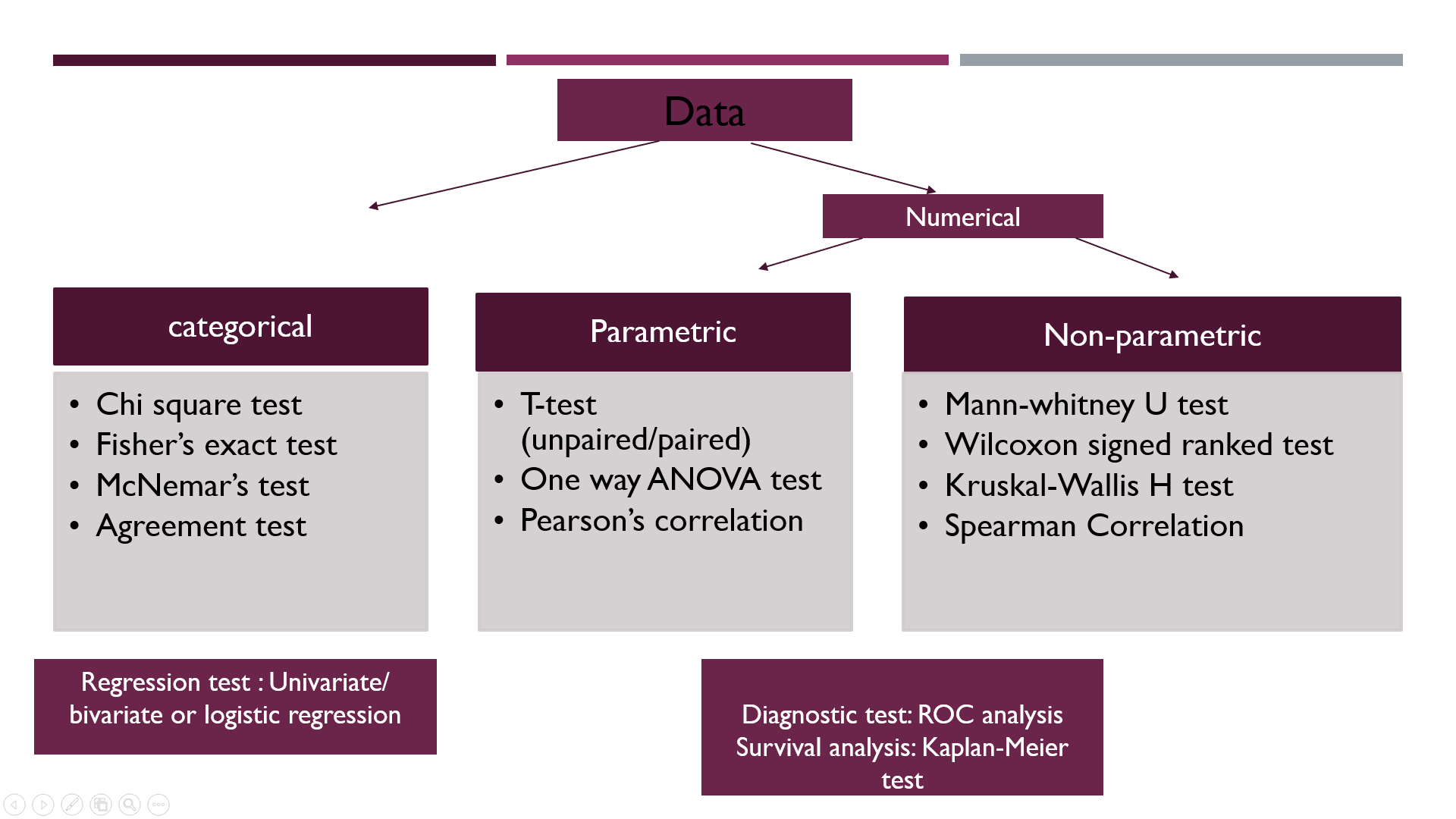
One of the most important steps in data analysis is selecting the appropriate statistical test. The choice mainly depends on the type of data, distribution of numerical variables, number of groups being compared and study objective.
🔹 Categorical data
Commonly used tests include:
Chi-square test – association between categorical variables
Fisher’s exact test – useful when expected cell frequencies are small
McNemar’s test – comparison of paired categorical data
Agreement tests – assessment of agreement between observers or methods
🔹 Numerical data
When the assumptions for parametric analysis are satisfied:
Independent/paired t-test
One-way ANOVA
Pearson’s correlation
When data are non-normally distributed or parametric assumptions are not met:
Mann–Whitney U test
Wilcoxon signed-rank test
Kruskal–Wallis test
Spearman’s rank correlation
Beyond simple comparisons, the statistical approach depends on the research question. Regression analysis can identify factors associated with an outcome and adjust for potential confounders. ROC analysis can assess the discriminative ability of a test or marker, while Kaplan–Meier analysis is commonly used to describe time-to-event or survival outcomes.